Aline Andres, PhD, RD

The Beginnings Study and Beginnings Follow-Up Study represent some of the most comprehensive prospective research examining the long-term health effects of infant feeding practices.1 The studies evaluated a broad range of outcomes including growth, body composition, bone health, cardiovascular health, reproductive development, neurodevelopment, and metabolic health. The studies involved adolescents who were healthy, full-term infants fed soy protein-based formula, cow's milk-based formula, or human milk.
For health professionals counseling families about infant feeding options, the findings are particularly valuable because they provide long-term data extending from infancy into adolescence. While breastfeeding remains the recommended infant feeding mode, the Beginnings findings offer important reassurance regarding the safety of soy infant formula and help address longstanding concerns about its effects on growth, development, and reproductive health.
About the Study
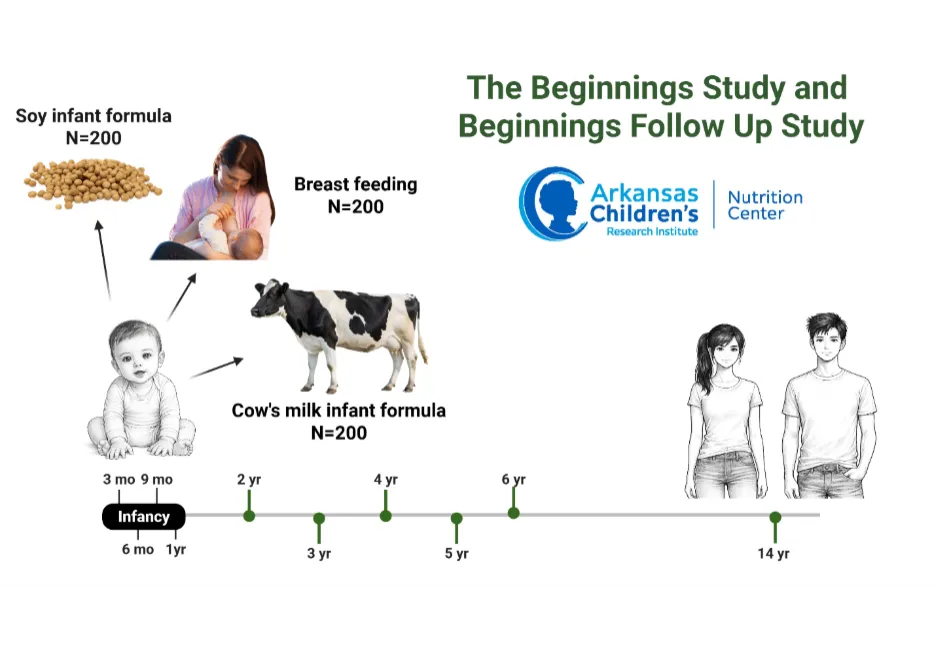
The original Beginnings Study, initiated in 2002, enrolled 600 healthy term infants in Arkansas, with 200 infants in each of the following feeding groups: soy formula, cow's milk formula, and human milk. Participants were followed throughout infancy and childhood, with assessments conducted at regular intervals through age 6. A subset of participants later returned for the Beginnings Follow-Up Study at approximately 14 years of age, allowing researchers to evaluate adolescent outcomes (Figure 1).
A key consideration when interpreting the findings is that this research was an observational cohort study rather than a randomized controlled trial. Parents selected their infant's feeding method before enrollment, reflecting real-world feeding decisions. While this design limits the ability to establish causality, it provides clinically relevant information about outcomes associated with feeding choices as they occur in practice.
The study is notable for its breadth of assessment. Researchers evaluated dietary intake, growth, body composition, bone mineral density, reproductive organ development, pubertal maturation, neurodevelopment, autonomic nervous system function, microbiome composition, metabolomic biomarkers, and metabolic markers. No other infant feeding study has examined such a wide range of outcomes over such an extended period.
Figure 1: The Beginnings Study and Beginnings Follow-Up Study

Key Clinical Message: More Similarities Than Differences
Perhaps the most important overall finding is that there were substantially more similarities than differences between infants fed soy formula and cow's milk formula.
Across childhood and adolescence, soy formula was not associated with adverse differences in growth, skeletal development, reproductive health, pubertal maturation, or most measures of cognitive function. These findings are particularly important because concerns regarding soy formula have historically centered on its phytoestrogen content and the possibility that exposure to isoflavones during infancy could adversely affect endocrine, reproductive, or developmental outcomes later in life. Additionally, the studies reaffirmed findings consistently observed throughout the breastfeeding literature. Compared with formula feeding, breastfeeding was associated with lower adiposity and more favorable body composition measures later in life, as well as some early neurodevelopmental advantages.
Taken together, the findings support breastfeeding as the preferred feeding method while providing reassurance that soy formula remains a reasonable and safe alternative when breastfeeding is not possible, desired, or clinically appropriate.
Growth and Body Composition
One of the clearest patterns observed throughout the study involved differences between breastfed and formula-fed infants. During infancy, breastfed infants demonstrated slower weight gain and lower weight-for-length measurements than formula-fed infants. These findings are consistent with a substantial body of literature suggesting that breastfed infants follow a different growth trajectory than formula-fed infants. The differences persisted beyond infancy. Throughout childhood, children who had been breastfed generally exhibited lower BMI z-scores and lower fat mass indices compared with children who had received formula. By adolescence, those who had been breastfed continued to demonstrate lower fat mass indices and smaller waist circumferences. Importantly, the study did not identify meaningful differences between the soy formula and cow's milk formula groups. Adolescents who had received soy formula during infancy generally fell between the breastfed and cow's milk formula groups on body composition measures and were not significantly different from either group.
For clinicians, these findings reinforce two important messages. First, breastfeeding appears to confer long-term advantages related to adiposity and body composition. Second, soy formula does not appear to increase obesity risk or adversely affect body composition compared with standard cow's milk formula.
Bone Health and Skeletal Development
Bone health has historically been an area of concern regarding soy formula because soy contains phytates that may affect mineral bioavailability. Questions have also been raised about whether isoflavone exposure could influence skeletal development. The Beginnings Study provides some of the strongest prospective evidence available addressing these concerns.
Researchers observed some differences in bone mineral content during infancy. Breastfed infants demonstrated higher bone mineral content early in life, whereas formula-fed infants showed higher bone mineral content later in infancy. However, these early differences did not persist.
Through childhood and adolescence, researchers found no significant differences among feeding groups in bone mineral density or major skeletal outcomes. Assessments using dual-energy X-ray absorptiometry (DXA) and peripheral quantitative computer tomography (pQCT) demonstrated comparable bone health regardless of whether infants had received soy formula, cow's milk formula, or human milk.
Reproductive Development and Pubertal Outcomes
The reproductive findings are among the most clinically significant contributions of the Beginnings studies. Concerns have been raised that isoflavone exposure during infancy could affect reproductive organ development, alter pubertal timing, or influence future reproductive health. These concerns were addressed by using serial ultrasound evaluations and long-term follow-up into adolescence.
Researchers observed a small number of differences in reproductive organ size and characteristics during infancy. For example, some differences among groups in ovarian volume and ovarian cyst prevalence were identified among infant girls, while differences in testicular volume were observed among infant boys. However, these findings were transient and did not persist over time. By 5 years of age and again at adolescence, there were no significant differences among feeding groups in reproductive organ size or characteristics. Similarly, researchers found no differences in pubertal maturation. Measures including sexual maturity ratings and age at menarche were comparable across feeding groups.
These findings are particularly important because they represent data collected prospectively over more than a decade. Unlike retrospective studies, the Beginnings cohort tracked participants from infancy through adolescence using standardized assessments and direct imaging methods. For clinicians discussing soy formula with families, the evidence from Beginnings provides strong reassurance that soy formula exposure during infancy is not associated with measurable adverse effects on reproductive development or pubertal timing through adolescence.
Neurodevelopment and Cognitive Outcomes
Understanding the neurodevelopmental findings is more complicated than other outcomes. On average, each group of infants in the study developed within normal ranges, regardless of feeding method. Across infancy, childhood, and adolescence, researchers did not identify evidence suggesting that soy formula negatively affected overall cognitive development.
Breastfed infants demonstrated some advantages in early cognitive and language-related measures as well as speech-processing patterns and cortical activity (EEG/EFP) during specific developmental windows. Researchers also observed differences in language-processing measures between breastfed and soy-fed infants. However, these findings were generally modest, varied across time points, and often disappeared as children aged. Most importantly, these early neurophysiological differences did not translate into clinically meaningful differences in overall cognitive performance. By 6 years of age, no significant differences were found among feeding groups in full-scale IQ, memory, language skills, or overall cognitive functioning.
Microbiome, Metabolomics, and Physiologic Findings
The research also generated valuable data regarding microbiome composition, metabolomics, and autonomic nervous system development. As expected, there were distinct microbial profiles among feeding groups. Breastfed infants demonstrated microbiome patterns commonly associated with human milk feeding, including greater abundance of Bifidobacterium and Bacteroides species. Soy-fed infants displayed unique microbial signatures, reflective of plant-based dietary intake, and greater microbial diversity than the other two groups. Similarly, urinary metabolomic analyses revealed distinct biochemical profiles among soy-fed infants, reflecting differences in nutrient composition and metabolism. While these findings are scientifically interesting, their clinical significance remains uncertain. Importantly, these differences did not translate into adverse health outcomes during childhood or adolescence. The primary value of these findings is that they confirm that soy formula represents a biologically distinct nutritional exposure.
Strengths and Limitations
The Beginnings Study and Beginnings Follow-Up Study possess several important strengths that enhance confidence in its findings. The studies were prospective, followed participants for many years, and included a relatively large sample size for a deep phenotype of the cohort. Researchers employed rigorous assessment methods including DXA imaging, reproductive ultrasonography, electroencephalogram, standardized neurodevelopmental testing, detailed dietary records (three-day food records), and statistical adjustment for multiple social and parental factors.
At the same time, important limitations should be recognized. Because the study was observational, unmeasured differences among feeding groups may have influenced outcomes. The breastfeeding group was also not fully breastfed for the entire first year, as ~57% of participants transitioned to cow's milk formula before age 12 months. Participant attrition represents another limitation. Only a subset of the original cohort completed adolescent follow-up assessments, raising the possibility of selection bias. However, a comparison of the completers vs. non-completers only identified a significant difference in feeding group, with more participants in the breastfeeding group completing the 14-year visit compared to the participants in the formula groups. Finally, the formulas studied reflected products available in the early 2000s. Although the findings remain highly relevant, clinicians should recognize that some product formulations have evolved since the study began.
Implications for Clinical Practice
The Beginnings studies provide some of the most comprehensive long-term evidence available regarding soy infant formula. The findings reinforce the recommendation that breastfeeding remains the preferred method of infant feeding and is associated with favorable body composition outcomes and some early neurodevelopmental advantages. Across more than a decade of follow-up, researchers found no evidence that soy formula adversely affected growth, bone health, reproductive development, pubertal maturation, or overall cognitive function.
See All Articles in this issue
- da Cruz LL, Shlisky J, Bellando BJ, et al. Longitudinal evaluation from birth to adolescence of soy protein–based infant formula compared with cow milk–based formula and breastfeeding: A comprehensive summary of findings. Adv Nutr. 2026;100669. doi:10.1016/j.advnut.2026.100669. https://www.sciencedirect.com/science/article/pii/S2161831326000839.

Aline Andres
PhD, RD
Aline Andres, PhD, RD, is professor of developmental nutrition in the department of pediatrics at University of Arkansas for Medical Sciences and project leader at the Arkansas Children’s Nutrition Center. Her research focuses on the impact of maternal and children’s nutrition and metabolism on cardiometabolic health.