
By Kacie Barnes, MCN, RDN
Walk down almost any grocery aisle today and you’ll see shoppers scanning barcodes with their phones. A brightly colored score pops up, quickly categorizing foods as “good”, “bad”, or somewhere in between.
For many, food rating apps have become a go-to shortcut to healthier eating. They don’t have to fumble through label reading to guess if a product is healthy — there’s an app for that.
Among these tools, the Yuka app has gained significant traction, particularly among those seeking to avoid ultra-processed foods and food additives. While the appeal is understandable, these apps raise important questions for health professionals: How are foods being evaluated? What scientific assumptions are built into these scores? And how might these tools influence dietary behaviors and perceptions of various foods?1
How Food Rating Apps Work: Yuka as a Case Study
Food rating apps typically scan a product’s barcode and assign a numerical score and/or color-coded rating intended to summarize its “healthfulness”. Yuka’s scoring system is based on three components: overall nutritional quality (60%), the presence of food additives (30%), and whether the product is organic (10%).2
The nutritional quality component is derived from the Nutri-Score system, which weighs nutrients including calories, saturated fat, sugar, sodium, fiber, protein, and fruit and vegetable content. Nutri-Score was developed by French public health researchers and adopted by the French government in 2017 as a voluntary front-of-pack labeling system. It was intended to aid consumers in quickly assessing nutritional content of a product, and to encourage food manufacturers to improve the nutrition of their products.3
However, Yuka layers their own additional criteria onto this foundation. Food additives are penalized based on hazard classifications rather than exposure-based risk assessments. That means they evaluate based on the question, “Could this substance ever be harmful, in any amount?” instead of, “Is this harmful at the amount we actually consume?”4 And if a product is organic, it contributes positively to the score, regardless of nutrient composition.
Why These Apps Resonate with Consumers
From a behavioral standpoint, food rating apps tap into several powerful motivators. They reduce decision fatigue, provide instant feedback, and align with growing public skepticism toward processed foods. Many users say that scanning products encourages them to consider ingredient lists and nutrition labels more closely — often for the first time.5
From a public health lens, this increased engagement with food labels and formulation is not inherently negative. Awareness is often a necessary first step toward behavior change. But awareness alone does not equal understanding.
Where Food Rating Apps Oversimplify Healthy Eating
The most significant limitation of food rating apps lies in how they collapse complex nutritional and formulation realities into binary judgments. A single score cannot account for portion size, dietary context, frequency of consumption, or individual health needs. Foods are evaluated in isolation, divorced from the dietary patterns in which they are actually consumed.
Food additive scoring presents another challenge. Many additives penalized by apps like Yuka serve important functions like improving shelf stability, food safety, texture, and nutrient delivery.4 Hazard-based classifications, when removed from regulatory context and real-world exposure levels, can unintentionally frame all additives as inherently harmful rather than functionally neutral or beneficial.6-8 In the Yuka app, any food without additives includes the claim, “no hazardous substances,” making it seem like any food with additives is hazardous/dangerous.
This approach and accompanying strong negative language around all additives can amplify fear around foods that are widely consumed and considered safe, particularly for children.
Similarly, the “good” versus “bad” language embedded in many scoring systems risks reinforcing moralized views of food. For some individuals, especially those prone to rigidity or anxiety around eating, these tools amplify fear rather than foster informed choice.
Using Food Rating Apps as Educational Tools, Not Verdicts
Despite their limitations, food rating apps are unlikely to disappear — and outright dismissal can alienate clients who feel empowered by these tools. Instead, health professionals can play a critical role in reframing how these apps are used.
Practical guidance includes:
-
Encouraging patients/clients to view scores as conversation starters, not final judgments.
-
Redirecting focus toward key nutrients of concern (fiber, added sugars, sodium, saturated fat) rather than composite scores.
-
Explaining the functional role of additives and the difference between hazard and risk.
-
Reinforcing that nutrition quality is determined by patterns over time, not individual foods in isolation.
-
Guiding patients/clients with food allergies or sensitivities to use apps as a tool for identifying certain ingredients they need to avoid.
Dietitian-Recommended Digital Alternatives
Apps that support nutrient tracking, meal planning, or food journaling can complement clinical counseling by increasing awareness without moralizing food choices or creating unnecessary fear.
One app called Open Food Facts allows users to filter and highlight nutrition information based on individual priorities, like avoiding allergens, or limiting sodium or saturated fat. It also uses the Nutri-Score nutrition rating system, but it is more personalized and guides users toward products that fit their individual needs. For example, a user can search for granola that is dairy free and low in saturated fat, and it will provide “best fit” options based on those specific parameters.
Conclusion: The Role of Health Professionals in a Scored Food World
Food rating apps reflect a real consumer desire for clarity, transparency, and control in an increasingly complex food environment. While they can promote engagement and awareness, they also risk oversimplifying nutrition and reinforcing misconceptions about processed foods.
For health professionals, the opportunity lies not in endorsing or rejecting these tools outright, but in helping patients interpret them and use them appropriately. In a world where algorithms increasingly shape food choices, professional insight remains essential in guiding people toward healthy eating patterns, not just to the products that receive an “A” grade.
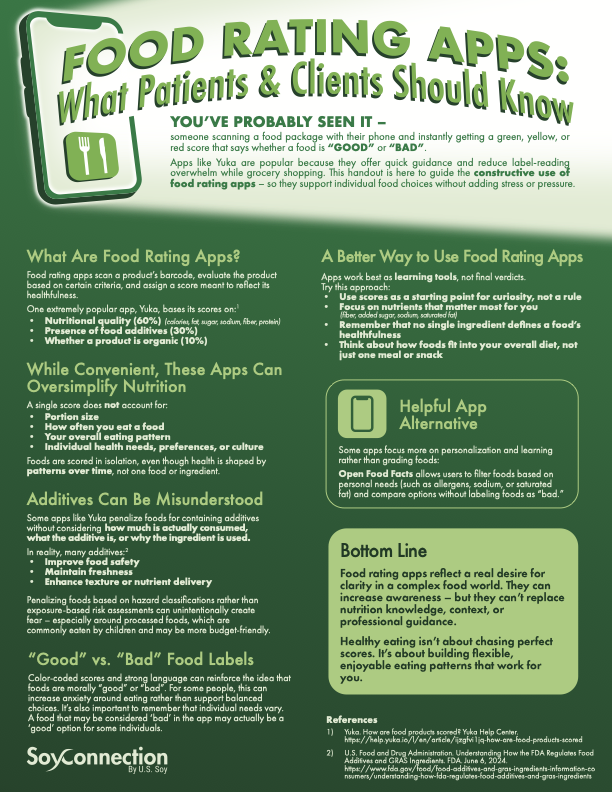
Download Healthy Handout for Patients and Clients
REFERENCES
-
Hughes GJ, Ryan DJ, Mukherjea R, Schasteen CS. Protein digestibility-corrected amino acid scores (PDCAAS) for soy protein isolates and concentrate: criteria for evaluation. J Agric Food Chem. 2011 Dec 14;59(23):12707-12. doi: 10.1021/jf203220v. Epub 2011 Nov 16. PMID: 22017752.
-
Messina M. Perspective: Soybeans can help address the caloric and protein needs of a growing global population. Frontiers in nutrition. 2022;9:909464.
-
USDA. Production - Soybeans2025. Available from: https://www.fas.usda.gov/data/production/commodity/2222000.
-
USDA. Soybeans, mature seeds, raw. Fooddata Central [Internet]. Available from: https://fdc.nal.usda.gov/food-details/174270/nutrients.
-
American Soybean Association. Animal Agriculture2025. Available from: https://soygrowers.com/key-issues-initiatives/key-issues/other/animal-ag/.
-
Bukowski M, Swearingen B. More soybeans being processed in United States to meet rising demand for soybean meal and oil. Charts of Note [Internet]. 2025. Available from: https://www.ers.usda.gov/data-products/charts-of-note/chart-detail?chartId=112861#:~:text=According%20to%20the%20USDA's%20Economic%20Research%20Service %2C,as%20a%20feedstock%20in%20biomass%2Dbased%20diesel%20production
-
Ramsey S. Renewable diesel production surpasses biodiesel. Charts of Note [Internet]. 2024. Available from: https://www.ers.usda.gov/data-products/charts-of-note/chart-detail?chartId=109240#:~:text=As%20this%20portion%20of%20the,46%20percent%20in%202022/23.
-
Ijaz S. 15 most consumed edible oils In the world2023. Available from: https://finance.yahoo.com/news/15-most-consumed-edible-oils-141827709.html.
-
Messina M, Shearer G, Petersen K. Soybean oil lowers circulating cholesterol levels and coronary heart disease risk, and has no effect on markers of inflammation and oxidation. Nutrition. 2021;89:111343.
-
Blasbalg TL, Hibbeln JR, Ramsden CE, Majchrzak SF, Rawlings RR. Changes in consumption of omega-3 and omega-6 fatty acids in the United States during the 20th century. Am J Clin Nutr. 2011;93:950-62.9.
-
U.S. Food and Drug Administration. “Soybean Oil and Reduced Risk of Coronary Heart Disease.” July 31, 2017. https://www.fda.gov/media/106649/download
-
International Food Information Council. Americans' perceptions of seed oils. 2025.
-
Ravandi B, Ispirova G, Sebek M, Mehler P, Barabasi AL, Menichetti G. Prevalence of processed foods in major US grocery stores. Nat Food. 2025;6:296-308.
-
Wu Y, Wang T. Soybean lecithin fractionation and functionality. JAOCS. 2003;80:319-26.
-
Onaolapo MC, Alabi OD, Akano OP, et al. Lecithin and cardiovascular health: a comprehensive review. The Egyptian Heart Journal. 2024;76:92.
-
Niu YY, Yan HY, Zhong JF, et al. Association of dietary choline intake with incidence of dementia, Alzheimer disease, and mild cognitive impairment: a large population-based prospective cohort study. Am J Clin Nutr. 2025;121:5-13.
-
Trautwein EA, Demonty I. Phytosterols: natural compounds with established and emerging health benefits. OCL. 2007;14:259-66.
-
Jones PJ, MacDougall DE, Ntanios F, Vanstone CA. Dietary phytosterols as cholesterol-lowering agents in humans. Can J Physiol Pharmacol. 1997;75:217-27.
-
Matvienko OA, Lewis DS, Swanson M, et al. A single daily dose of soybean phytosterols in ground beef decreases serum total cholesterol and LDL cholesterol in young, mildly hypercholesterolemic men. Am J Clin Nutr. 2002;76:57-64.
-
Yang Y, Xia J, Yu T, Wan S, Zhou Y, Sun G. Effects of phytosterols on cardiovascular risk factors: A systematic review and meta-analysis of randomized controlled trials. Phytother Res. 2025;39:3-24.
-
Tian M, Bai Y, Tian H, Zhao X. The chemical composition and health promoting benefits of vegetable oils-A review. Molecules. 2023;28.
-
Macoska JA. The use of beta-sitosterol for the treatment of prostate cancer and benign prostatic hyperplasia. Am J Clin Exp Urol. 2023;11:467-80.
-
Hughes GJ, Ryan DJ, Mukherjea R, Schasteen CS. Protein digestibility-corrected amino acid scores (PDCAAS) for soy protein isolates and concentrate: Criteria for evaluation. J Agric Food Chemistry. 2011;59:12707-12.
-
Rutherfurd SM, Fanning AC, Miller BJ, Moughan PJ. Protein digestibility-corrected amino acid scores and digestible indispensable amino acid scores differentially describe protein quality in growing male rats. J Nutr. 2015;145:372-9.
-
Emmert JL, Baker DH. Protein quality assessment of soy products. Nutr Res. 1995;15:1647-56.
-
Zhang S, de Vries S, Gerrits WJJ. Quantifying the effects of dietary fibres on protein digestibility in pigs - A review Animal Feed Science Technology. 2024;308:115684.
-
Yilmaz Tuncel N, Polat Kaya H, Andac AE, Korkmaz F, Tuncel NB. A comprehensive review of antinutrients in plant-based foods and their key ingredients. Nutr Bull. 2025;50:171-205.
-
Friedman M. Nutritional value of proteins from different food sources. A review. J Agr Food Chem. 1996;44:6-29.
-
Reynaud Y, Buffiere C, Cohade B, et al. True ileal amino acid digestibility and digestible indispensable amino acid scores (DIAASs) of plant-based protein foods. Food Chem. 2020;338:128020.
-
Fanelli NS, Bailey HM, Thompson TW, Delmore R, Nair MN, Stein HH. Digestible indispensable amino acid score (DIAAS) is greater in animal-based burgers than in plant-based burgers if determined in pigs. Eur J Nutr. 2022;61:461-75.
-
Muoki PN, de Kock HL, Emmambux MN. Effect of soy flour addition and heat-processing method on nutritional quality and consumer acceptability of cassava complementary porridges. J Sci Food Agric. 2012;92:1771-9.
-
Bookwalter GN. Soy protein utilization in food systems. Adv Exp Med Biol. 1978;105:749-66.
-
Jones F. Study finds soy ingredients are a growing trend. Food & Drink Digital [Internet]. 2020. Available from: https://fooddigital.com/food/study-finds-soy-ingredients-are-growing-trend.
-
Taghdir M, Mazloomi SM, Honar N, Sepandi M, Ashourpour M, Salehi M. Effect of soy flour on nutritional, physicochemical, and sensory characteristics of gluten-free bread. Food science & nutrition. 2017;5:439-45.
-
Bakhsh A, Lee SJ, Lee EY, Hwang YH, Joo ST. Characteristics of beef patties substituted by different levels of textured vegetable protein and taste traits assessed by electronic tongue system. Foods. 2021;10:1-15.
Connect with us through our social channels