
By Dennis P. Cladis, PhD, and Mario G. Ferruzzi, PhD
It is impossible to miss the growing and intense discussions surrounding processed foods in scientific research, popular media, and the newly released 2025-2030 Dietary Guidelines for Americans.1 Headlines often highlight health concerns linked to ultra-processed foods and food additives, raising questions about how everyday foods are made and delivered, their health effects, and their future role in American diets. This has led to an all-time low in U.S. consumers’ confidence in the safety of the U.S. food supply.2 Americans are looking for more transparency from both food companies and the government, with ~40% of consumers saying they would have higher confidence in the U.S. food supply if they better understood how companies and the government work to ensure that foods and food products are safe for consumption.2
While some evidence suggests that processed foods may impact health in different ways than “whole” foods, public discussion often oversimplifies and discounts the role food processing plays in providing a safe, affordable, and nutritious food supply. This situation highlights the need for a deeper understanding of how and why food is produced commercially, including formulation with regulated food ingredients/additives, processing and packaging, and a better understanding of how government regulations serve to protect consumers in this space.
To help provide transparency for health professionals, their patients, and scientists new to the area of food, this article explores the role of food ingredients and additives, as well as their synergy with food processing techniques to create foods that are safe, affordable, palatable, and nutritious. This illustrates how modern food systems continue to focus on balancing quality, safety, affordability, and accessibility for the population.
Why Do We Process Food?
All food is inherently perishable because it comes from living systems that deteriorate immediately after harvest. In 2021, post-harvest losses totaled over 13% of global food production, with almost 19% at retail and in the home.3 These losses hit developing nations hardest, limiting the availability of safe and nutritious food. One possible solution is to grow more food, but we are quickly running out of the resources (like farmland and water) needed to feed 8.2 billion people. To minimize food waste and maximize the availability and affordability of perishable food globally, we need effective post-harvest management, which includes food processing, that can preserve the food we already grow and raise.
Food processing, in the broadest sense, can be defined as “any deliberate change in a food occurring between the point of origin and availability for consumption.”4 Food processing can increase shelf life, inactivate spoilage and pathogenic microorganisms, add convenience, and preserve the sensory and nutritional qualities of food.4 Processing is not a modern invention. It has played a central role in food preservation for thousands of years, using techniques like salting or smoking meat, fermenting vegetables and milk, and separating milk to produce cheese. These traditional techniques extend shelf life and are still used in home food preparation today, as heat from your oven or stove is used to cook food and spices in your pantry are added to enhance the taste and aroma of finished food.4
Why Do We Process Foods on a Commercial Scale?
Commercially, these same food processing techniques are applied on a much larger scale, one that is designed for high efficiency and broad distribution. Commercial food processing is supported by equipment designed to convert agricultural products, such as grains, meats, vegetables, fruits, and milk, into ingredients and/or processed food products. This approach helps manage the high amounts of seasonally produced food by making products that are affordable, safe, and nutritious available for a longer period of time.
Commercial food processing, like home cooking, uses ingredients chosen for specific sensory, nutritional, and functional qualities. Common examples include flour, sugar (sucrose), salt (sodium chloride), and vinegar (acetic acid). It also incorporates functional additives such as antioxidants (e.g., BHT, ascorbic acid), hydrocolloids and thickeners (e.g., corn starch, xanthan gum, guar gum), emulsifiers (e.g., lecithin), and preservatives (e.g., benzoic and propionic acids) to enhance the shelf life of products which must last longer than home-cooked products due to the need to distribute and minimize losses.
“Processing” can be broken down into unit operations that include simpler steps (e.g., washing, peeling, mixing, heating, cooling) or more complicated operations (e.g., filtering, fermenting, pressurizing, freeze drying).4 For example, canned peas may seem as easy as adding peas to a can and heating them, but in fact is a process that typically involves 10+ unit operations: receiving, shelling, sorting (color and size), blanching, filling, formulating (salt addition), heat sterilizing, labeling, secondary packaging (boxing), and palatizing (bulk packaging) all prior to shipping to local grocery stores.
So, the term “processed food” refers to all food products created by combining food ingredients or additives (i.e., food formulation) with one or more processing steps (i.e., unit operations).4 Processed foods, and those who produce them, strive to meet consumer expectations for flavor, texture, shelf life, nutritional and health benefits, price, and convenience. By leveraging modern food manufacturing and distribution systems, commercial food processing provides national scalability of safe and affordable foods while also increasing the availability and security of food.
What Are Food Ingredients and Additives and What is Their Role in a Safe and Stable Food Supply?
Ingredient selection and formulation by product developers is similar to home recipe development, but with an additional need to meet strict safety and stability standards while delivering a high-quality product that meets consumer expectations. Each ingredient selected for a formula plays one or more roles in food, influencing how it behaves during processing, storage, and even during consumption and digestion. Ingredients also help meet consumer expectations for taste, aroma, and mouthfeel. In processed foods, the selection of ingredients, including food additives, is guided by the chemistry and physics of the food. Thinking back to canned peas, salt is added not only for taste but to improve texture of the peas as they undergo thermal treatment.
The primary goal of ingredient selection and formulation is to create a finished product that is not only fundamentally safe but also has desirable sensory properties. Ingredients can modify food structure/texture (e.g., viscosity, gelation), water activity (aw – the availability of water in food for biological and chemical use), and acidity (pH), all of which modify flavor, texture, shelf stability, and safety by controlling microbial growth and enzymatic and chemical reactions in foods. To highlight the factors critical to spoilage of foods by microorganisms, enzymes, and other biochemical processes, the acronym FATTOM (Food, Acid, Time, Temperature, Oxygen, Moisture) is often used.5
Many ingredients used in processed foods are classified as food additives, which are defined by the FDA as:
“any substance the intended use of which results … in its becoming a component or otherwise affecting the characteristic of any food … All food additives are subject to premarket review and approval by FDA unless the substance is considered generally recognized as safe (GRAS) or sanctioned prior to 1958 or otherwise excluded from the definition of food additives.”6
GRAS ingredients are considered safe by qualified experts under their intended conditions of use. The main difference between GRAS ingredients and broader food additives is the type of information that supports the GRAS determination. For GRAS ingredients, the supporting information must be publicly available and generally accepted by the scientific community.6 More information on the GRAS process is available from FDA for those interested.7
Ingredients and additives can be broadly classified according to their chemical properties and/or function, as shown in the table below (adapted from Igoe (2011)8 and FDA6, 9):
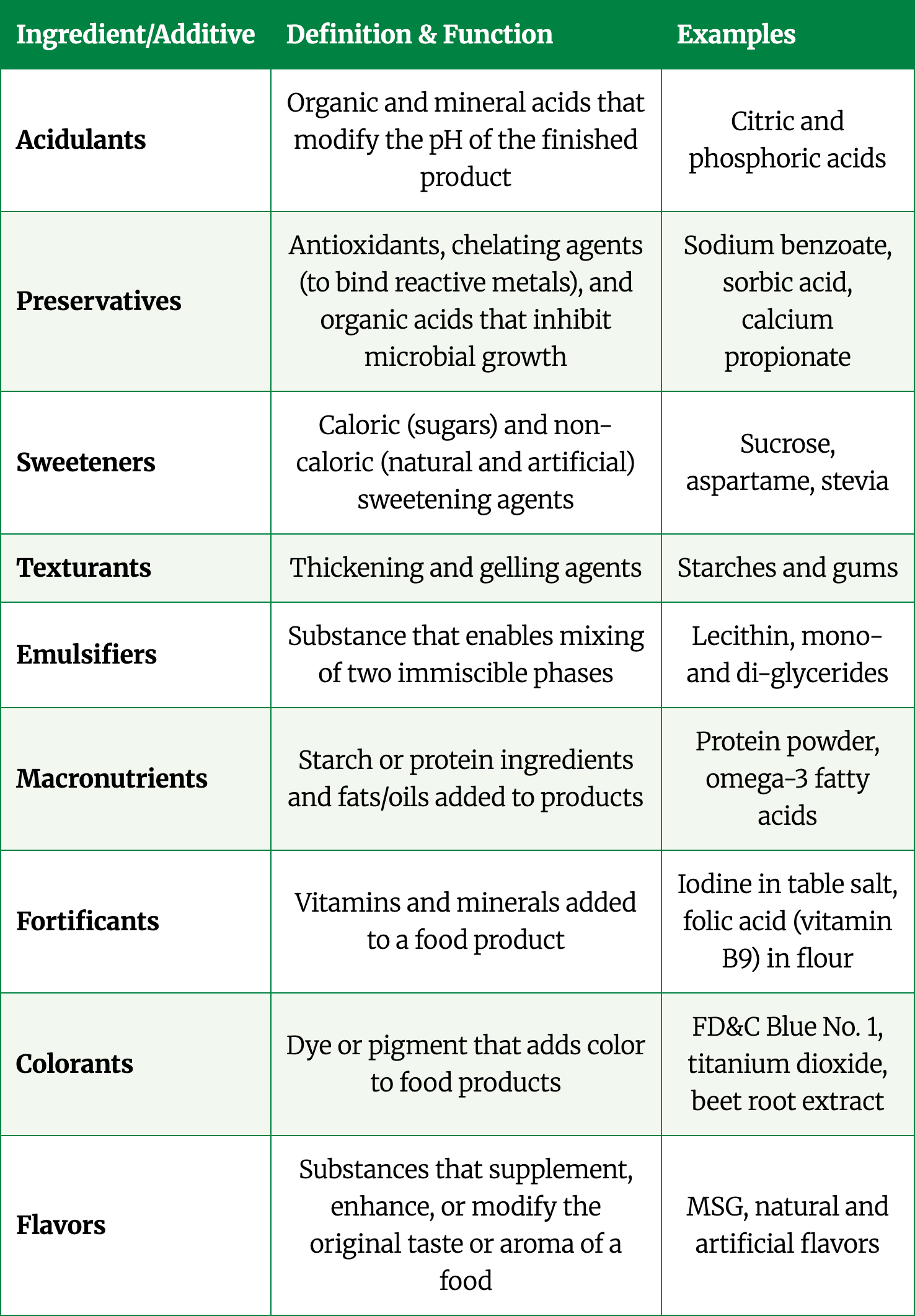
| Ingredient/Additive | Definition & Function | Examples |
|---|---|---|
| Acidulants | Organic and mineral acids that modify the pH of the finished product | Citric and phosphoric acids |
| Preservatives | Antioxidants, chelating agents (to bind reactive metals), and organic acids that inhibit microbial growth | Sodium benzoate, sorbic acid, calcium propionate |
| Sweeteners | Caloric (sugars) and non-caloric (natural and artificial) sweetening agents | Sucrose, aspartame, stevia |
| Texturants | Thickening and gelling agents | Starches and gums |
| Emulsifiers | Substance that enables mixing of two immiscible phases | Lecithin, mono- and di-glycerides |
| Macronutrients | Starch or protein ingredients and fats/oils added to products | Protein powder, omega-3 fatty acids |
| Fortificants | Vitamins and minerals added to a food product | Iodine in table salt, folic acid (vitamin B9) in flour |
| Colorants | Dye or pigment that adds color to food products | FD&C Blue No. 1, titanium dioxide, beet root extract |
| Flavors | Substances that supplement, enhance, or modify the original taste or aroma of a food | MSG, natural and artificial flavors |
The FDA maintains a list of over 3,000 ingredients that are added to food in the U.S. Detailed information on the nature and function of specific ingredients is available from the FDA10 or from other references such as the Dictionary of Food Ingredients.8
Examples of Industrial Food Processing Methods
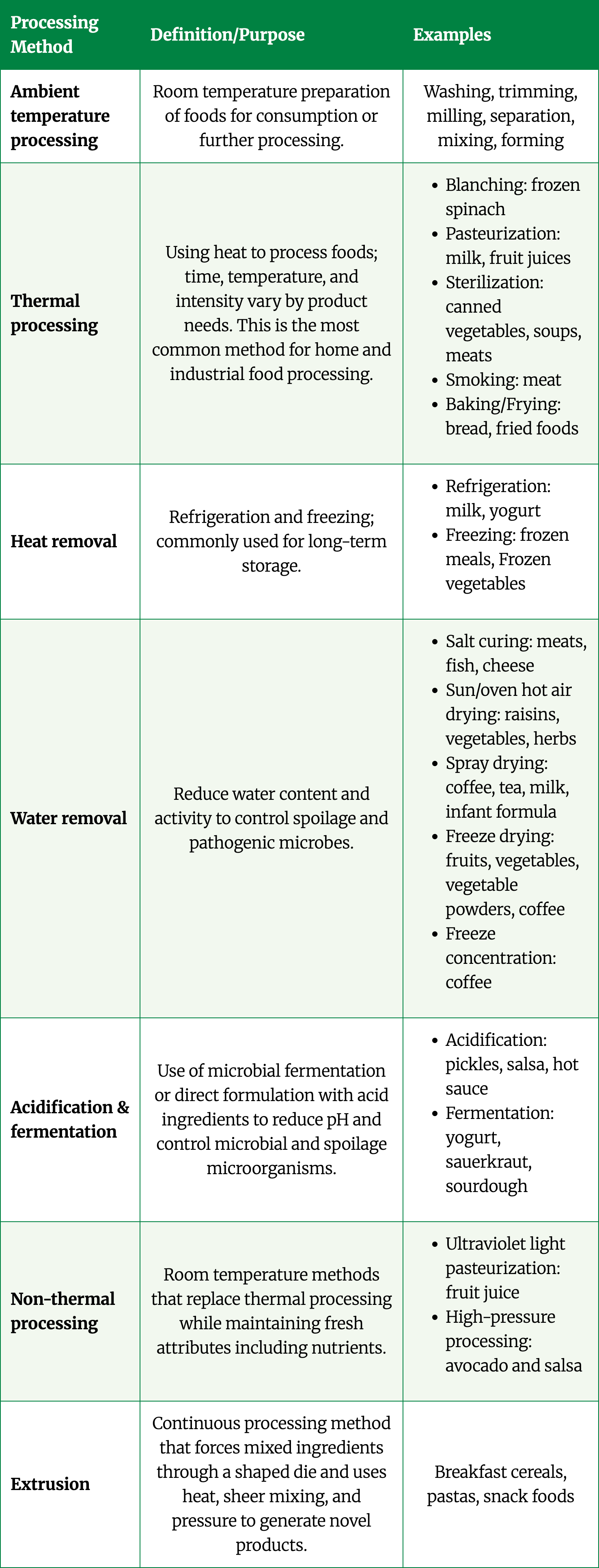
Many industrial food processing methods do have parallels to in-home cooking (e.g., thermal treatment, acidification, fermentation), while others are really only used industrially (e.g., extrusion and high-pressure processing). While it is impossible to capture the full range of physical processing methods used industrially, a classification of major industrial processing methods is shown below (adapted from Fellows (2017)11):
| Processing Method | Definition/Purpose | Examples |
|---|---|---|
| Ambient temperature processing | Room temperature preparation of foods for consumption or further processing. | Washing, trimming, milling, separation, mixing, forming |
| Thermal processing | Using heat to process foods; time, temperature, and intensity vary by product needs. This is the most common method for home and industrial food processing. |
|
| Heat removal | Refrigeration and freezing; commonly used for long-term storage. |
|
| Water removal | Reduce water content and activity to control spoilage and pathogenic microbes. |
|
| Acidification & fermentation | Use of microbial fermentation or direct formulation with acid ingredients to reduce pH and control microbial and spoilage microorganisms. |
|
| Non-thermal processing | Room temperature methods that replace thermal processing while maintaining fresh attributes including nutrients. |
|
| Extrusion | Continuous processing method that forces mixed ingredients through a shaped die and uses heat, sheer mixing, and pressure to generate novel products. | Breakfast cereals, pastas, snack foods |
Depending on ingredient functionality and the desired characteristics of the final food product, these methods can be used in combination to make both simple and complex products. For example, to make a simple, extruded oat breakfast cereal, multiple processing unit operations may be applied. First, raw oats are received, cleaned, and ground into whole grain flour that is mixed with sweeteners, salt, and fortificants (i.e., vitamins and minerals). Water is added and the blend introduced into an extruder, where it is exposed to high sheer mixing, pressure, and heat that continuously cooks the cereal as it moves through the extruder before exiting through a die that promotes puffing (expansion) of the product. This process results in a puffed cereal which can be further coated with additives, including flavor or coloring agents, before being packaged.
How Are Processed Foods Regulated?
To protect consumers, all foods and food products are regulated by agencies at the federal, state, and local levels. These regulations apply to processed foods and the ingredients used to make them, with the goal of protecting consumers from adulteration and false labeling, preventing foodborne illnesses, and ensuring consumers are not exposed to unsafe levels of food ingredients or additives.
The FDA has created standards of identity (SOIs) for over 250 foods to prevent food fraud. SOIs are detailed descriptions that define what a food must contain, what ingredients are optional, the amount or proportion of each ingredient, and the production methods used.12 These regulations protect consumers and food processors by defining foods and their components.
Food processing and manufacturing facilities must also comply with laws designed to prevent foodborne illnesses and maintain high quality food products for consumers. These laws include Current Good Manufacturing Practices (CGMP), Hazard Analysis Critical Control Point (HACCP), and the Food Safety Modernization Act (FSMA). These laws are complementary and work together to ensure the safety of foods produced in processing facilities. CGMPs regulate the design and construction of food processing facilities, employee hygiene, and the sanitary use and maintenance of food processing equipment.13 HACCP is a systematic protocol to monitor biological, chemical, and physical hazards associated with foods, from raw materials to finished product.14 FSMA focuses on preventing contamination rather than responding to outbreaks and provides the FDA with more authority to regulate food safety at all points in the supply chain and initiate recalls.15 Combined, these regulations guide companies in safely producing food on a large scale.
A Comment on Ultra-Processed Foods (UPFs)
There are many headlines and debates regarding ultra-processed foods (UPFs), also referred to as “highly processed foods” in the 2025-2030 Dietary Guidelines for Americans. Like all processed foods, UPFs are composed of ingredients that are processed in a specific way to make a food product that meets consumer expectations and is safe to consume. UPFs are formulated and regulated in the same manner as all other processed foods; the apparent difference between “processed foods” and “UPFs” appears to be the degree of formulation and (to a lesser extent) processing applied to the product. As with all processed foods, UPFs provide consumers with desirable products, including new product forms, that have extended shelf lives and are generally more affordable.
The oat-based breakfast cereal described above exemplifies the importance of evaluating foods based on nutrient, fiber, and bioactive content; not the degree to which they have been processed. Even within the same processing category, foods can differ greatly in nutritional value. For example, a vitamin- and mineral-fortified protein shake and a typical pastry may be classified similarly, yet they offer very different nutritional contributions. When health concerns are linked to diets high in UPFs, it is often because these diets tend to be low in overall nutritional quality — not because processing itself determines health outcomes.
Summary
Food processing and the use of safe, regulated ingredients and additives are essential for delivering a safe, nutritious, and affordable food supply. While headlines often oversimplify and malign food processing, it plays a critical role in reducing food waste, extending shelf life, preserving nutrition, and ensuring food safety, all while meeting consumer expectations for taste, texture, and convenience. Ingredients and additives are selected for functional purposes, and modern food systems integrate these ingredients to make safe food products that fulfill consumer expectations. Food processing remains a cornerstone of global food systems and security, enabling access to safe, high-quality, and affordable foods to meet the needs of a growing population.
REFERENCES
-
United State Department of Agriculture (USDA). Dietary Guidelines for Americans 2025-2030. 2026. Available at: https://www.dietaryguidelines.gov/ (accessed 9 Jan 2026).
-
International Food Information Council (IFIC). 2025 IFIC Food & Health Survey: A Focus On Food & Ingredient Safety. 2025. Available at: https://ific.org/research/2025-food-health-survey (accessed 9 Jan 2026).
-
Food & Agriculture Organization of the United Nations (FAO). Technical Platform on the Measurement and Reduction of Food Loss and Waste. Available at: https://www.fao.org/platform-food-loss-waste/en (accessed 7 Jan 2026).
-
Floros, J.; Newsome, R.; Fisher, W.; et al. Feeding the World Today and Tomorrow: The Importance of Food Science and Technology An IFT Scientific Review. Comprehensive Reviews In Food Science And Food Safety 2010, 9 (5), 572-599.
-
Ertop, D.; Morgan, M. FATTOM – Factors Affecting Bacterial Growth in Food (D267). 2025. Available at: https://utia.tennessee.edu/publications/wp-content/uploads/sites/269/2025/12/D267.pdf (accessed 7 Jan 2026).
-
Code of Federal Regulations (CFR). 21 CFR pt 170 Food Additives. 2025. Available at: https://www.ecfr.gov/current/title-21/chapter-I/subchapter-B/part-170 (accessed 31 Dec 2025).
-
Food and Drug Administration (FDA). Generally Recognized as Safe (GRAS). 2023. Available at: https://www.fda.gov/food/food-ingredients-packaging/generally-recognized-safe-gras (accessed 9 Jan 2026).
-
Igoe, R. Dictionary of Food Ingredients; Springer Science & Business Media, 2011. Available at: https://link.springer.com/content/pdf/10.1007/978-1-4419-9713-5.pdf (accessed 9 Jan 2026).
-
Code of Federal Regulations (CFR). 21 CFR pt 70 Color Additives. 2025. Available at: https://www.ecfr.gov/current/title-21/chapter-I/subchapter-A/part-70 (accessed 31 Dec 2025).
-
Food and Drug Administration (FDA). Substances Added to Food. Available at: https://hfpappexternal.fda.gov/scripts/fdcc/index.cfm?set=FoodSubstances (accessed 7 Jan 2026).
-
Fellows, P. Food Processing Technology: Principles and Practices; Woodhead Publishing, 2017. Available at: https://www.sciencedirect.com/book/monograph/9781845692162/food-processing-technology (accessed 9 Jan 2026).
-
Food and Drug Administration (FDA). Standards of Identity for Food. 2025. Available at: https://www.fda.gov/food/nutrition-food-labeling-and-critical-foods/standards-identity-food (accessed 31 Dec 2025).
-
Code of Federal Regulations (CFR). 21 CFR pt 117. 2025. Available at: https://www.ecfr.gov/current/title-21/chapter-I/subchapter-B/part-117 (accessed 31 Dec 2025).
-
Food and Drug Administration (FDA). HACCP Principles & Application Guidelines. 2022. Available at: https://www.fda.gov/food/hazard-analysis-critical-control-point-haccp/haccp-principles-application-guidelines (accessed 31 Dec 2025).
-
Food and Drug Administration (FDA). Food Safety Modernization Act (FSMA). 2017. Available at: https://www.fda.gov/food/food-safety-modernization-act-fsma/full-text-food-safety-modernization-act-fsma (accessed 31 Dec 2025).
Connect with us through our social channels