
By Mark Messina, PhD, MS
Despite extensive research on ultra-processed foods (UPFs), no single universally accepted definition of this term exists. In July of this year, the U.S. Department of Agriculture and the U.S. Food and Drug Administration released a request for information (RFI) to assist the government in establishing a uniform definition for UPFs. The RFI outlines six key areas for public comment (Table A). Currently, state legislative bodies use different definitions when enacting legislation related to these foods.
Nova and the Rise of UPFs in Nutrition Research
The term UPF was used even prior to 2009 when Brazilian researchers created the Nova food classification system that included a group of foods referred to as ultra-processed,1-3 but it is only after Nova rose to prominence that UPFs entered the nutrition lexicon. Nova categorizes foods into one of four groups based on degree of processing and formulation. In 2024, 693 papers on UPFs were indexed in PubMed, representing a six-fold increase since 2018. Although numerous food classification systems include a category of highly processed foods,5,8 Nova is the system most used in research.
A Global Issue
The concept of UPFs has been incorporated into dietary guidelines from at least a dozen countries.4 In contrast, the U.S. Dietary Guidelines Advisory Panel concluded that more study was needed before including recommendations about UPFs in the 2025-2030 Dietary Guidelines for Americans. Even so, Americans are becoming familiar with this term. In 2025, more than 44% of the 1,000 U.S. adults surveyed indicated they are familiar with the term “ultra-processed food,” a 12-point jump from 2024.5 UPFs are commonly perceived as foods that are high in energy, sugar, and sodium, and low in fiber. Online searches for the term “junk food” and UPFs return similar images.
Despite the considerable amount of research conducted on UPFs, the author of a recent commentary in the New England Journal of Medicine concluded that "… adoption of a national nutrition policy focused on Nova — and on UPF, in particular, could do more harm than good, by misguiding consumers and the food industry and imposing costs and burdens on the public…".6 Forde, a prominent researcher in this field,7 also recently criticized Nova, saying "Fundamentally, the UPF category doesn’t discriminate between foods that are good and bad for us."8 And, in their recent paper, one of the criticisms lodged by Bernstein et al.9 against food classification systems based on processing and formulation is the ambiguity in definitions, purpose, and methodology.
There is debate among nutrition scientists about the extent to which the adverse health effects associated with UPFs10 result from their poor nutritional quality and/or to the poor dietary pattern associated with higher consumption of these foods, as opposed to other inherent properties of UPFs. There is evidence supporting both perspectives.7,11 Importantly, Hess et al.11 showed that it is possible to adhere to a diet comprised of ~90% UPFs, still achieve a healthy eating score that is considerably higher than the U.S. average, and contain adequate amounts of most macro- and micronutrients.Not All UPFs Are Equal: Differential Health Effects
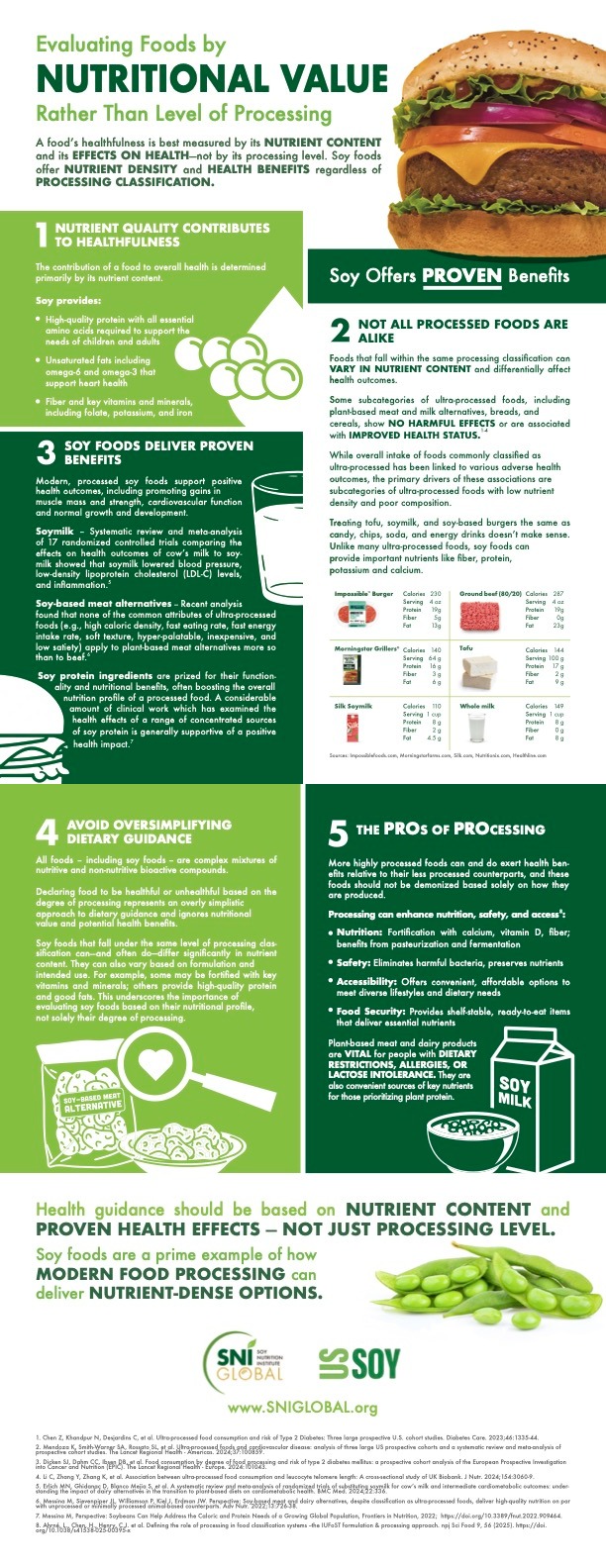
There is no disagreement that foods with vastly different nutrient profiles and overall health attributes are included in the UPF category. This point is evident from a simple comparison of nutrient content as well as the results of observational studies showing that subgroups of UPFs differentially affect health outcomes. Generally, the association between total UPF intake and adverse health outcomes is driven by two categories: processed meats and sugar sweetened beverages.12,13 These findings emphasize the importance of identifying the characteristics of UPFs that account for their adverse effects, so that consumers can limit their intake of foods with these characteristics and also so that the food industry can consider reformulation to minimize these characteristics. There has been progress toward achieving this goal.
UPF intake has been consistently linked with obesity.14 UPFs are typically energy dense, (kcal/g) and can be quickly eaten (eating rate, g/min), two attributes that potentially lead to a high energy intake rate (kcal/min), and excess caloric intake and weight gain. A 2019 study by Hall and colleagues16 found that over just a two-week period, a diet high in UPFs led to a nearly 1 kg gain in body weight whereas there was nearly a 1 kg loss of weight when participants consumed a diet low in UPFs. Participants consumed ~500 kcal/d more when on the high-UPF diet.
The findings by Hall et al.16 are consistent with research by Lasschuijt et al.,17 who compared the effects on caloric intake of four meals that varied in eating rate (slow or fast) and energy density (3.8 vs. 1.9 kcal/g). Participants consumed ~50% fewer calories (570 kcal vs. 1,143 kcal) when eating the low energy density, slow eating rate meal in comparison to the high energy density, fast eating rate meal. In alignment, when study participants were provided with two eight-week ad libitum diets following the UK Eatwell Guide, weight loss was twice as great on the pattern built around minimally processed food compared to meals that incorporated UPFs, although subjects experienced weight loss on both plans.15
Eating rate is determined primarily by texture and energy density. Energy density, which played the biggest role in the increased caloric intake in the study by Lasschuijt et al.,17 is determined primarily by fiber, water, and fat content. The importance of energy density and eating rate indicates that nutrient content remains a crucial factor in the health impact of UPFs. Finally, Finlayson et al.16 recently set out to determine the nutritional, sensory, and cognitive characteristics and attributes of foods that impact food reward-related outcomes. Based on their three studies, they concluded that whether a food is ultra-processed has a negligible influence on self-reported food liking and hedonic overeating.
Nevertheless, there may be constituents common to UPFs that impact health in ways not fully understood. Recently published research provides unique insight into the constituents of UPFs that possibly contribute to their adverse health effects. Krost et al.17 examined the relationship between the intake of 37 markers of ultra-processed foods (MUPs) and mortality among participants in the UK Biobank. MUPs are food ingredients that include cosmetic additives, such as flavor agents, coloring agents, and sweeteners, and nonculinary ingredients, such as fructose, modified oil, and isolated protein. If at least one MUP is found in a food item, it is considered a UPF.
Over a mean follow-up of 11.0 years, 10,203 deaths occurred among the 186,744 participants. After adjustment for a range of potential confounders, five MUP categories were significantly associated with mortality: flavor agents, flavor enhancers, coloring agents, sweeteners, and varieties of sugar. In addition, 12 specific MUPs were positively associated with all-cause mortality: glutamate, ribonucleotide, acesulfame, saccharin, sucralose, caking agent, firming agent, thickener, fructose, inverted sugar, lactose, and maltodextrin. One MUP gelling agent was inversely related to mortality. A total of 20 specific MUPs, including interesterified fat, fiber, and protein isolates, were unrelated to risk. Adjustment for diet quality did not substantially alter the results. Krost et al.17 recommended that intervention studies focus on the MUPs associated with harmful effects.
Despite the adjustments made, these findings on MUPs stem from an observational study, so it would be premature to conclude—without substantial clinical evidence—that any of the identified MUPs should be avoided. The work by Krost et al. simply highlights that if certain UPFs negatively affect health independent of nutrient content, understanding the underlying reasons is important, as such insights could inform future product reformulation.
Moving Forward: Refining Definitions and Research Priorities
In summary, several lines of evidence challenge the utility of the Nova food classification system for serving as a guide for consumer food purchasing decisions. Observational studies indicate that foods Nova-classified as ultra-processed differentially affect health outcomes. Recent research highlights the characteristics of foods that are likely to contribute to excessive caloric intake. More research is needed to determine whether there are characteristics common to ultra-processed foods independent of nutrient content that contribute to their reported adverse health outcomes.
Table A: U.S. Food and Drug Administration RFI for public comment
- Classification Systems: Input is sought on existing classification systems and their applicability to the U.S. context, including benefits and limitations.
- Ingredient Labeling: Comments are requested on how ingredient prominence and function (e.g., flavorings, colorings, preservatives) should influence UPF classification.
- Processing Methods: The RFI explores how physical, biological, and chemical processing techniques (e.g., extrusion, fermentation, pH adjustment) may define UPFs.
- Terminology: Stakeholders are asked whether “ultra-processed” is the most appropriate term or if alternatives would better capture public health concerns.
- Nutritional and Sensory Attributes: The agencies seek views on incorporating factors like energy density, palatability, and nutrient composition into a UPF definition.
- Operationalization: The RFI requests ideas on how to systematically apply a UPF classification in food labeling, research, and policy
REFERENCES
-
Monteiro C. The big issue is ultra-processing. World Nutrition. 2010;1:237-69.
-
Monteiro CA. Nutrition and health. The issue is not food, nor nutrients, so much as processing. Public health nutrition. 2009;12:729-31.
-
Monteiro CA, Levy RB, Claro RM, Castro IR, Cannon G. A new classification of foods based on the extent and purpose of their processing. Cad Saude Publica. 2010;26:2039-49.
-
Vadiveloo MK, Gardner CD, Bleich SN, et al. Ultraprocessed foods and their association with cardiometabolic health: Evidence, gaps, and opportunities: a science advisory from the american heart association Circulation. 2025.
-
International Food Information Council (IFIC). IFIC Spotlight Survey: Americans' Perceptions of Dietary Guidance & Food Labeling. August 2025. https://ific.org/research/food-and-health-focus-on-dietary-guidance/.
-
Ludwig DS. Ultraprocessed food on an ultrafast track. N Engl J Med. 2025.
-
Beyond ultra-processed: considering the future role of food processing in human health. C. G. Forde Proc Nutr Soc 2023 Vol. 82 Issue 3 Pages 406-418.
-
Fleming N. Are ultra-processed foods really so unhealthy? What the science says. Nature. 2025;645:22-5.
-
Bernstein J, Brown A, Burton-Freeman B, et al. Perspective: Guiding principles for science-based food classification systems focused on processing and formulation. Preprintsorg. 2025.
-
Lane MM, Gamage E, Du S, et al. Ultra-processed food exposure and adverse health outcomes: umbrella review of epidemiological meta-analyses. BMJ. 2024;384:e077310.
-
J.M. Hess, M.E. Comeau, S. Casperson, J.L. Slavin, G.H. Johnson, M. Messina, et al. Dietary guidelines meet Nova: Developing a menu for a healthy dietary pattern using ultra-processed foods. J Nutr. 2023 Aug;153(8):2472-2481. doi: 10.1016/j.tjnut.2023.06.028. Epub 2023 Jun 24. PMID: 37356502. https://pubmed.ncbi.nlm.nih.gov/37356502/.
-
Mendoza K, Smith-Warner SA, Rossato SL, et al. Ultra-processed foods and cardiovascular disease: analysis of three large US prospective cohorts and a systematic review and meta-analysis of prospective cohort studies. The Lancet Regional Health - Americas. 2024;37:100859.
-
Kim Y, Cho Y, Kim JE, Lee DH, Oh H. Ultra-processed food intake and risk of type 2 diabetes mellitus: A dose-response meta-analysis of prospective studies. Diabetes Metab J. 2025.
-
Juul F, Martinez-Steele E, Parekh N, Monteiro CA. The role of ultra-processed food in obesity. Nature reviews Endocrinology. 2025.
-
Dicken SJ, Jassil FC, Brown A, et al. Ultraprocessed or minimally processed diets following healthy dietary guidelines on weight and cardiometabolic health: a randomized, crossover trial. Nat Med. 2025.
-
Hall KD, Ayuketah A, Brychta R, Cai H, Cassimatis T, Chen KY, Chung ST, Costa E, Courville A, Darcey V, Fletcher LA, Forde CG, Gharib AM, Guo J, Howard R, Joseph PV, McGehee S, Ouwerkerk R, Raisinger K, Rozga I, Stagliano M, Walter M, Walter PJ, Yang S, Zhou M. Ultra-Processed Diets Cause Excess Calorie Intake and Weight Gain: An Inpatient Randomized Controlled Trial of Ad Libitum Food Intake. Cell Metab. 2019 Jul 2;30(1):67-77.e3. doi: 10.1016/j.cmet.2019.05.008. Epub 2019 May 16. Erratum in: Cell Metab. 2019 Jul 2;30(1):226. doi: 10.1016/j.cmet.2019.05.020. Erratum in: Cell Metab. 2020 Oct 6;32(4):690. doi: 10.1016/j.cmet.2020.08.014. PMID: 31105044; PMCID: PMC7946062. https://pubmed.ncbi.nlm.nih.gov/31105044/.
-
Lasschuijt MP, Heuven LA, Gonzalez-Estanol K, Siebelink E, Chen Y, Forde CG. The Effect of Energy Density and Eating Rate on Ad Libitum Energy Intake in Healthy Adults-A Randomized Controlled Study. J Nutr. 2025 Aug;155(8):2602-2610. doi: 10.1016/j.tjnut.2025.06.006. Epub 2025 Jun 12. PMID: 40516651. https://pubmed.ncbi.nlm.nih.gov/40516651/.